Why Businesses Should Protect with IP Rights
When launching a business that aims to differentiate itself from competitors, and when continuing to improve that business, it is important to protect the products, technologies, brands, and other business assets you bring to market with intellectual property (IP) rights. This article uses game theory to explain why.
IP rights are exclusive rights: only the owner of an IP right may produce and sell products protected by that right. A company that has not been licensed by the IP owner cannot manufacture or sell such products.
To understand the essence of exclusive rights, consider the following simplified example.
Conditions:
- Two players, Player A and Player B, exist in the market for Product X
- The total market size is 10 million dollars
- A and B each hold an equal share of the market
- A holds Patent α; B holds Patent β
- Both α and β are valid, and design-arounds are impossible with respect to Product X
- Seeking an injunction costs 1 million dollars (e.g., attorney fees, court costs)
Under these conditions, if A considers enforcing the exclusive right conferred by Patent α, the game tree starting from A's perspective looks as follows.
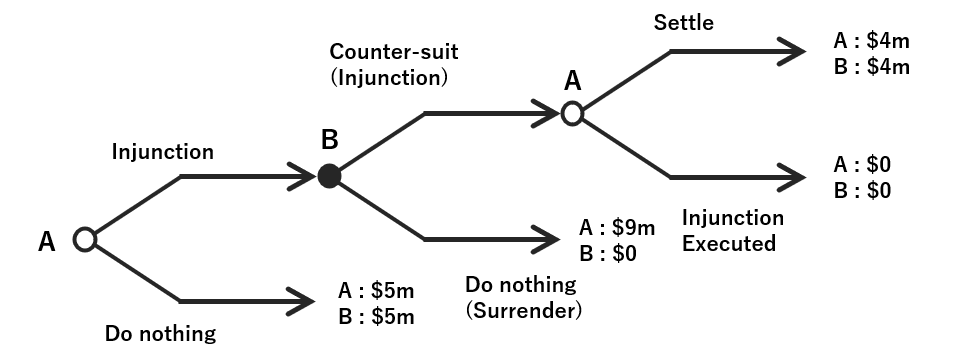
The game begins with Player A filing an infringement suit against Player B, seeking an injunction against Product X. B has essentially two choices: file a counter-suit seeking an injunction against A, or not file a counter-suit (do nothing). If B contests with a counter-suit, injunctions are issued against both A and B, because both parties infringe each other's patents. As a result, both A and B lose the profits from Product X. Alternatively, the parties may agree to withdraw their suits before a final injunction is issued.
Solving the game tree by backward induction — working backwards from the final payoffs in every scenario to determine the optimal action at each decision node — yields the following optimal choices for A and B.
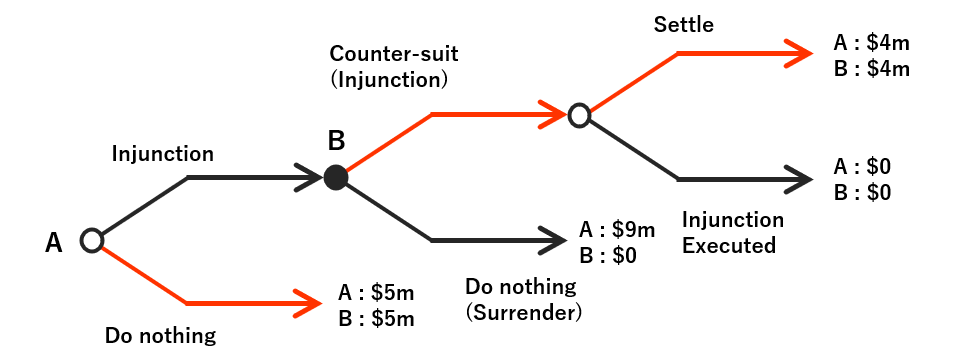
As shown, the best choice for each player is to do nothing. But what if B did not hold a patent essential to Product X? Without an essential patent, B cannot seek an injunction as a counterclaim, and the game tree changes as follows.
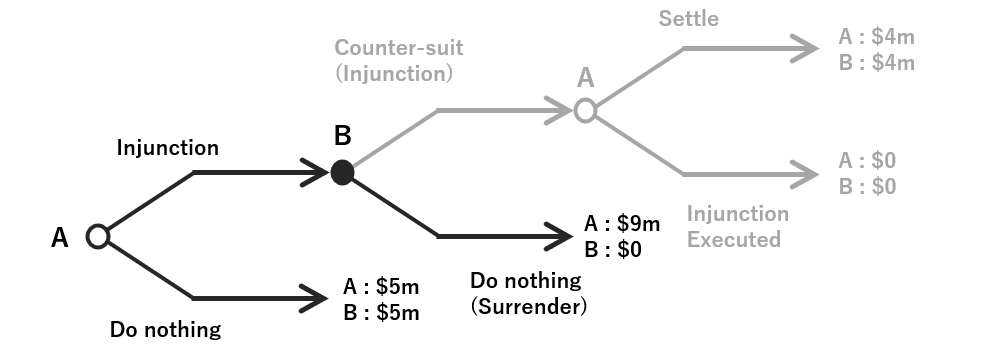
Backward induction gives the following result.
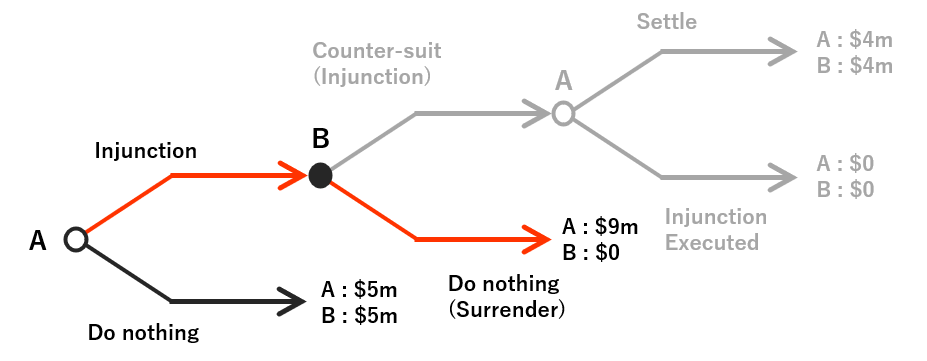
In other words, A gains more by seeking an injunction, while B has no counter-suit option. Therefore, A's best strategy is to file for an injunction against B and exclude B from the market for Product X.
As this game illustrates, a company that does not hold IP rights essential to Product X will be forced to exit the market.
Therefore, in order for a player to continue doing business in a market, it is critical to hold IP rights that are essential to that market.
Of course, the assumptions that Patents α and β are 100% valid, and that design-arounds and licensing are impossible, are not realistic. A full analysis must consider the overall business including markets beyond Product X, as well as the impact that enforcing IP rights may have on other markets.
However, incorporating too many factors at once makes the analysis extremely complex. For the purpose of understanding the core of IP rights — their exclusivity — it is important to first grasp this simplified theoretical framework as a foundation.