IP Deterrence vs. Nuclear Deterrence: A Game-Theoretic Comparison
In a previous article, game theory was used to explain how the exclusionary effect of IP rights creates deterrence. This deterrence is somewhat reminiscent of nuclear deterrence in an arms race. The following discussion explores this similarity.
1. The Arms Race (Nuclear Deterrence) Game
Consider a simplified game of interstate conflict.
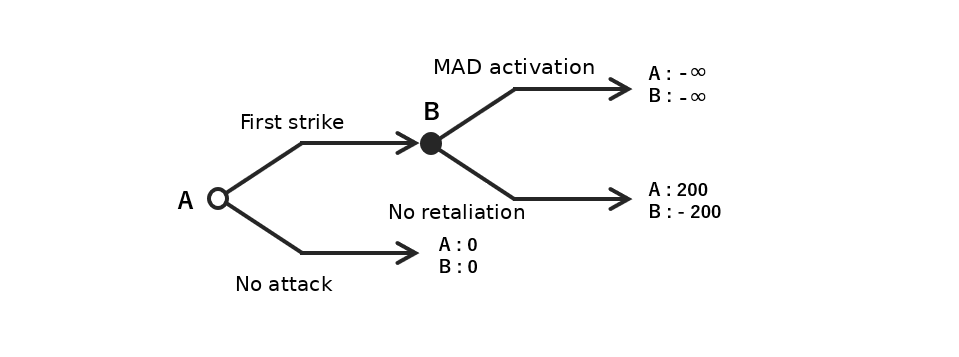
This model captures the logic of nuclear deterrence between two great powers e.g. during the Cold War — such as the United States and the Soviet Union — and assumes Mutual Assured Destruction (MAD): a posture that guarantees the attacked side's ability to retaliate with surviving nuclear forces even after a first strike, ensuring the attacker's certain destruction.
In this model, Player A first considers launching an initial attack, such as a conventional military invasion. Player B then faces options such as conventional retaliation, limited nuclear retaliation, or triggering MAD. For simplicity, B is assumed to have only two choices: "do not retaliate" or "retaliate, ultimately triggering MAD."
Solving by backward induction — working back from the final outcomes to determine the optimal action at each decision node — yields the following result.
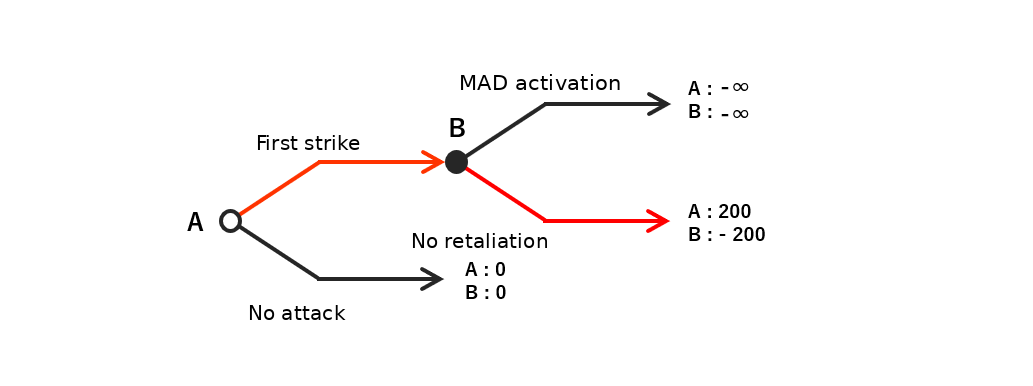
After receiving a first strike from A, B faces a choice between "trigger MAD (press the nuclear button, mutual annihilation: −∞)" and "do not retaliate (suffer serious damage but the state survives: −200)." Comparing the numbers rationally, −200 > −∞. That is, B will rationally choose "do not retaliate."
Anticipating this weakness, A reasons: "If I attack, B cannot (and will not) trigger MAD, so I win (200)."
In other words, the threat "attack us and you will be destroyed" is exposed as an empty bluff — a non-credible threat — and the conclusion becomes that striking first is advantageous. This illustrates the credibility problem at the heart of nuclear deterrence.
2. "Commitment" — Making Deterrence Credible
How does real nuclear strategy solve this problem? The answer lies in voluntarily eliminating one's own options — burning one's bridges. Specifically, the "do not retaliate" option is abandoned by B and made known to A.
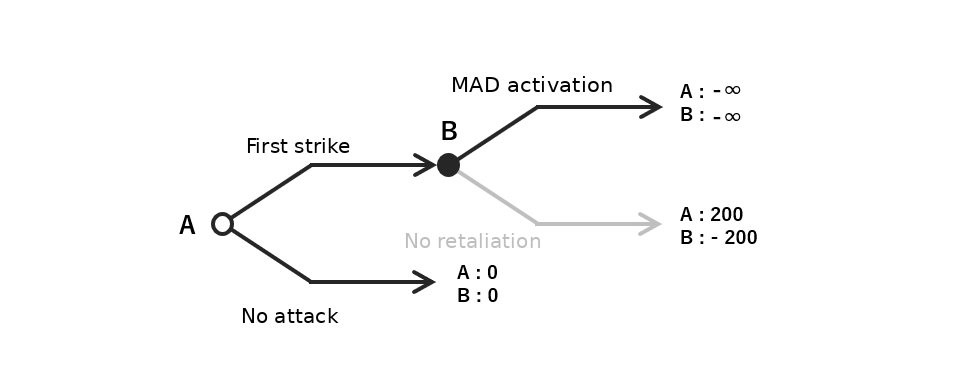
For example, a system is built that automatically launches retaliatory nuclear missiles (triggering MAD) upon detecting an enemy first strike — independently of any human decision — and this system is publicly announced. By doing so, B physically removes the otherwise rational option of "do not retaliate."
Once this state is established, A understands that "if I attack, destruction is inevitable (−∞) regardless of what B intends," and rationally chooses "do not attack (A: 0, B: 0)."
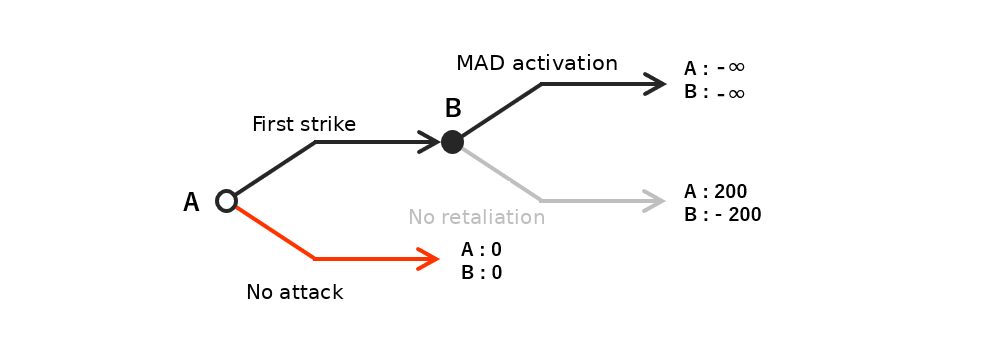
In this simplified model, nuclear deterrence works only by deliberately engineering a state in which an irrational action (retaliating and bringing mutual destruction) cannot be avoided.
3. The IP Game
Turning to the IP game, IP rights carry the power to exclude a competitor from the market through an injunction.
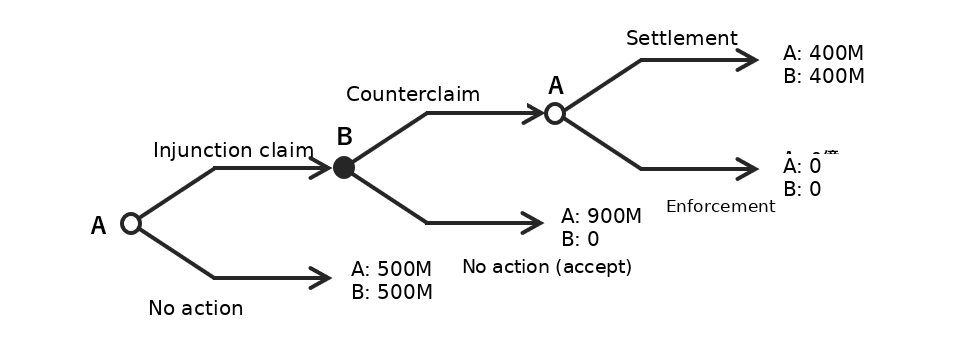
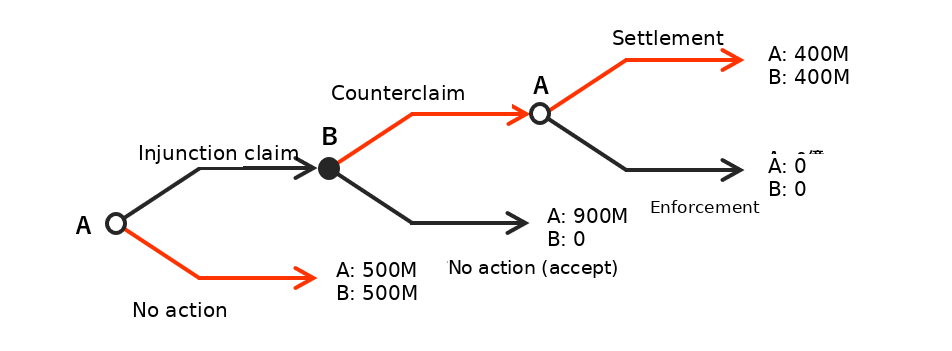
In this game, when A brings an infringement action seeking an injunction against B, B does not hesitate to file a countersuit (retaliate). This is because, in the IP game, retaliation — assuming both parties hold valid patents — does not mean total self-destruction (−∞) but rather leads to a "settlement in which both parties retain positive payoffs" outcome, giving B a rational reason to fight back.
Reasoning backward, A concludes: "Attacking will trigger a counter-suit from B, and a settlement will ultimately be reached, reducing my own profit." Accordingly, the optimal strategy for A from the outset is to "do nothing."
4. Conclusion
Nuclear deterrence required an "automatic commitment mechanism" — a system that forcibly removes the option of not retaliating — precisely because pressing the mutual-destruction button in a real crisis would be irrational.
IP rights (exclusive rights), by contrast, give the defending party a rational reason to counter-sue: counter-litigation creates bargaining leverage and limits the damage caused by the enforcement action brought by A and creates a path to settlement. The threat is therefore not a bluff, and deterrence can be credible without any artificial commitment device.
If a company holds essential patents, there is no need to construct dangerous tripwires or make irrational threats. The mere possession of those exclusive rights functions as a deterrent against competitors' aggressive moves.
This is why market players should acquire IP rights and build a sufficient portfolio.